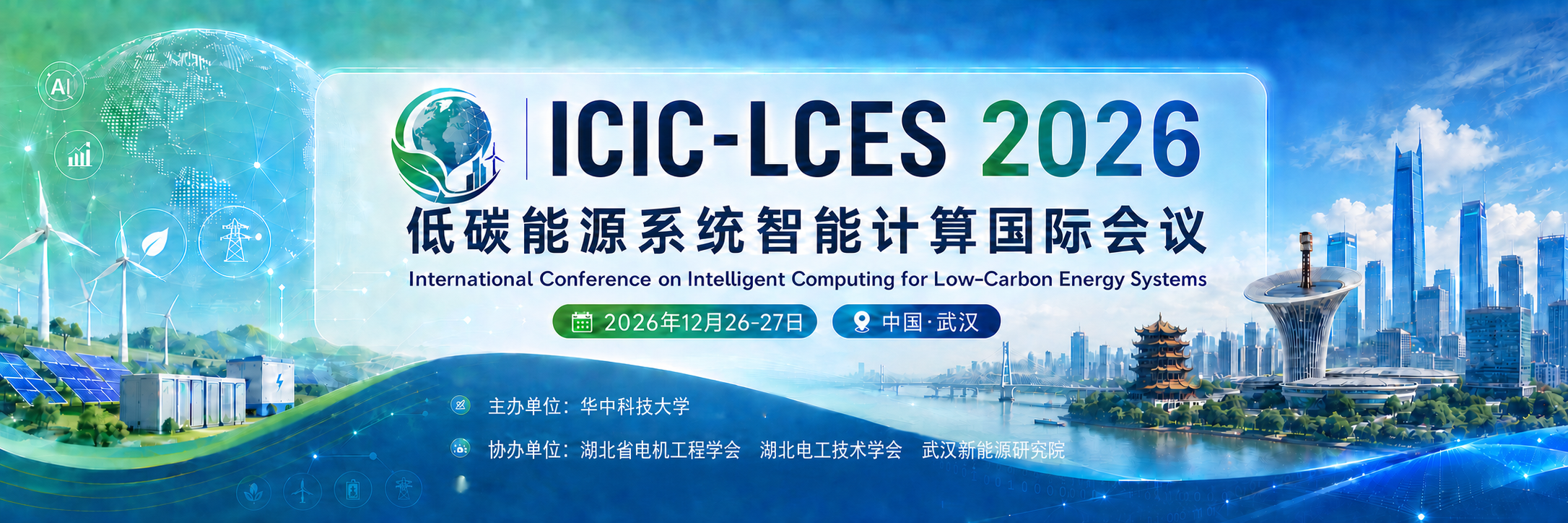
低碳能源系统智能计算国际会议
International Conference on Intelligent Computing for Low-Carbon Energy Systems
(ICIC-LCES 2026)
2026年12月26日-27日 | 中国 · 武汉
International Conference on Intelligent Computing for Low-Carbon Energy Systems
(ICIC-LCES 2026)
December 26-27, 2026 | Wuhan, China
重要日期
Important Dates
终轮截稿
Final Submission Deadline
2026年12月11日December 11, 2026
审核录用通知
Acceptance Notification
2026年12月18日
December 18, 2026
会议简介
About ICIC-LCES 2026
低碳能源系统智能计算国际会议(ICIC-LCES 2026)面向计算、人工智能、数据分析、优化、信息物理系统与低碳能源系统交叉领域,为国内外研究人员与工程实践者提供开放、专业的学术交流平台。
会议重点关注支撑低碳能源发电、转换、储存、输配、消费与碳管理的计算理论、算法、软件系统、平台、数据集与应用研究。征稿方向涵盖能源系统中的人工智能与机器学习、数据驱动建模、数字孪生、边云协同智能、能源物联网、优化与控制、可信人工智能、网络安全以及低碳能源基础设施的智能运行等。
电机、电机控制、电力电子与电力传动作为低碳能源系统中的重要能量转换与控制环节,纳入本会议范围。相关投稿应突出明确的计算贡献,例如数据驱动建模、智能控制、预测性维护、数字孪生、能效优化、嵌入式/边缘算法、变换器健康监测或系统级协同优化。仅限于传统硬件设计、器件制造、材料开发或常规工程实现且缺少清晰计算贡献的论文,不属于本会议主要范围。
The International Conference on Intelligent Computing for Low-Carbon Energy Systems (ICIC-LCES 2026) provides an international forum for researchers and practitioners working at the intersection of computing, artificial intelligence, data analytics, optimization, cyber-physical systems, and low-carbon energy systems.
The conference focuses on computational theories, algorithms, software systems, platforms, datasets, and applied studies that enable low-carbon energy generation, conversion, storage, delivery, consumption, and carbon management. Topics include, but are not limited to, AI and machine learning for energy systems, data-driven modeling, digital twins, edge/cloud intelligence, energy IoT, optimization and control, trustworthy AI, cybersecurity, and intelligent operation of low-carbon energy infrastructures.
Electric machines, motor control, power electronics, and electric drives are included as important energy-conversion and control components in low-carbon energy systems. Submissions in these areas should clearly present their computational contribution, such as data-driven modeling, intelligent control, predictive maintenance, digital twins, energy-efficiency optimization, embedded/edge algorithms, converter health monitoring, or system-level co-optimization. Papers limited to conventional hardware design, device fabrication, material development, or routine engineering implementation without a clear computing contribution are outside the primary scope of the conference.
本届国际会议聚焦智能计算技术在低碳能源系统中的理论创新、方法突破与工程实践,旨在搭建计算机科学、人工智能、电气工程与能源系统深度融合的高水平跨学科学术交流平台。
会议核心议题围绕如何利用先进智能计算范式,驱动低碳能源系统向高效、智能、安全、可持续方向演进。征文范围涵盖大数据分析、机器学习、智能控制、数字孪生、边缘/云计算、信息物理系统、可信AI与网络安全等关键技术,及其在能源生产、转换、存储、传输、消费与碳管理全链条中的应用。
会议尤为鼓励将计算机科学理论与电气能源物理系统深度耦合的研究工作,倡导以数据驱动、智能算法和协同优化为核心手段,解决低碳能源系统中的复杂工程问题。诚邀国内外学者、工程师及产业界人士踊跃投稿,共促智能计算与低碳能源的融合发展。
This international conference focuses on theoretical innovation, methodological breakthroughs, and engineering practices of intelligent computing technologies in low-carbon energy systems. It aims to establish a high-level interdisciplinary academic platform that fosters deep integration among computer science, artificial intelligence, electrical engineering, and energy systems.
The core topics of the conference revolve around how to leverage advanced intelligent computing paradigms to drive low-carbon energy systems toward greater efficiency, intelligence, security, and sustainability. The scope of topics covers key technologies including big data analytics, machine learning, intelligent control, digital twins, edge/cloud computing, cyber-physical systems, trustworthy AI, and cybersecurity, as well as their applications across the entire chain of energy generation, conversion, storage, transmission, consumption, and carbon management.
The conference especially encourages research that achieves deep coupling between computer science theories and electrical-energy physical systems, advocating data-driven approaches, intelligent algorithms, and collaborative optimization as core means to solve complex engineering problems in low-carbon energy systems. Scholars, engineers, and industry professionals from both domestic and international communities are cordially invited to submit their contributions and jointly promote the integrated development of intelligent computing and low-carbon energy.
组织机构
Organizers
主办单位
Host
协办单位
Co-Organizers
征稿主题
Call for Papers
征稿热点议题包括但不限于以下方向。
Hot topics for submission include but are not limited to the following areas.
计算机科学
Computer Science
- 大数据分析、数据挖掘与数据库技术
- 智能信息检索与推荐系统
- 高性能计算与并行计算方法
- 信号处理、信息融合与传感器网络
- Big data analytics, data mining, and database technologies
- Intelligent information retrieval and recommender systems
- High-performance computing and parallel computing methods
- Signal processing, information fusion, and sensor networks
人工智能
Artificial Intelligence
- 机器学习与深度学习理论及应用
- 专家系统、知识工程与推理机制
- 智能控制、机器人及自主系统
- 模糊逻辑、进化算法与群体智能
- Machine learning and deep learning: theories and applications
- Expert systems, knowledge engineering, and reasoning mechanisms
- Intelligent control, robotics, and autonomous systems
- Fuzzy logic, evolutionary algorithms, and swarm intelligence
电气工程
Electrical Engineering
- 电机、电器设计与驱动控制
- 电力电子变换器及电力传动技术
- 电磁场理论、微波与天线工程
- 传感技术、精密测量与仪器仪表
- Design and drive control of electric machines and apparatus
- Power electronic converters and electric drive technologies
- Electromagnetic field theory, microwave and antenna engineering
- Sensing technology, precision measurement, and instrumentation
能源系统
Energy Systems
- 可再生能源技术
- 能源存储与转换
- 光伏系统和太阳能工程
- 混合能源系统与微能源网
- Renewable energy technologies
- Energy storage and conversion
- Photovoltaic systems and solar engineering
- Hybrid energy systems and micro-energy grids
智能计算与低碳能源融合
Intelligent Computing and Low-Carbon Energy Integration
- 低碳能源系统数据驱动建模、仿真与优化
- 人工智能驱动的发电预测与电网稳定性评估
- 综合能源系统数字孪生与智能调控
- 碳排放智能核算、碳资产优化配置与低碳决策支持
- Data-driven modeling, simulation, and optimization of low-carbon energy systems
- AI-driven power generation forecasting and grid stability assessment
- Digital twins and intelligent regulation of integrated energy systems
- Intelligent carbon emission accounting, carbon asset optimization, and low-carbon decision support
低碳能源系统安全与可持续发展
Security and Sustainable Development of Low-Carbon Energy Systems
- 能源系统风险评估、韧性分析与安全控制
- 能源网络安全、数据隐私与可信计算
- 能源系统全生命周期评估与可持续决策
- 低碳政策智能分析与区域转型路径规划
- Risk assessment, resilience analysis, and security control of energy systems
- Energy cyber security, data privacy, and trustworthy computing
- Lifecycle assessment and sustainable decision-making for energy systems
- Intelligent analysis of low-carbon policies and regional transition pathway planning
人工智能与机器学习在低碳能源系统中的应用
Artificial Intelligence and Machine Learning for Low-Carbon Energy Systems
- 面向能源预测、异常检测、能效优化与碳排放估算的AI/ML方法
- 面向能源系统的深度学习、强化学习、图学习、迁移学习与物理信息机器学习
- 面向低碳能源应用的可解释、可信、鲁棒与隐私保护AI
- 能源资产的AI故障诊断、预测与健康管理
- AI/ML methods for energy forecasting, anomaly detection, energy-efficiency optimization, and carbon-emission estimation
- Deep learning, reinforcement learning, graph learning, transfer learning, and physics-informed machine learning for energy systems
- Explainable, trustworthy, robust, and privacy-preserving AI for low-carbon energy applications
- AI-enabled fault diagnosis, prognosis, and health management of energy assets
数据分析、数字孪生与智能运行
Data Analytics, Digital Twins and Intelligent Operation
- 能源数据采集、清洗、融合、标注与质量评估
- 低碳园区、综合能源系统、微电网、建筑与工业能源系统数字孪生
- 能源设备与系统的预测性维护、寿命评估、风险评估与决策支持
- 面向能源管理的知识图谱、语义建模与数据驱动决策支持
- Energy data acquisition, cleaning, fusion, labeling, and quality assessment
- Digital twins of low-carbon campuses, integrated energy systems, microgrids, buildings, and industrial energy systems
- Predictive maintenance, lifetime estimation, risk assessment, and decision support for energy equipment and systems
- Knowledge graphs, semantic modeling, and data-driven decision support for energy management
智慧建筑、低碳园区与工业能效
Smart Buildings, Low-Carbon Campuses and Industrial Energy Efficiency
- AI赋能的建筑能源管理、暖通优化与以人为中心的能耗控制
- 低碳园区能源管理、综合能源站与区域能源系统
- 工业能效优化、过程能耗分析与设备级智能控制
- 面向建筑、园区与工业设施的能源物联网、边缘控制器、传感系统与软件平台
- AI-enabled building energy management, HVAC optimization, and human-centric energy control
- Low-carbon campus energy management, integrated energy stations, and district energy systems
- Industrial energy-efficiency optimization, process energy analytics, and equipment-level intelligent control
- Energy IoT, edge controllers, sensing systems, and software platforms for buildings, campuses, and industrial facilities
能碳管理、MRV与碳数据智能
Energy-Carbon Management, MRV and Carbon Data Intelligence
- 碳排放测量、报告与核证的数据模型、算法与平台
- 能耗、碳排放、成本与舒适性的联合优化
- 碳数据治理、可信数据共享与计算型碳核算
- 面向碳管理、碳资产与低碳运行评价的决策支持系统
- Data models, algorithms, and platforms for measurement, reporting, and verification of carbon emissions
- Joint optimization of energy consumption, carbon emissions, cost, and comfort
- Carbon data governance, trusted data sharing, and computational carbon accounting
- Decision support systems for carbon management, carbon assets, and low-carbon operation evaluation
信息物理能源系统、安全与可信平台
Cyber-Physical Energy Systems, Security and Trustworthy Platforms
- 面向低碳能源系统的CPS/IoT架构、边云协同与实时计算
- 能源系统中的网络安全、隐私保护、联邦学习与安全数据共享
- 开放数据集、仿真环境、软件平台与可复现实验基础设施
- 关键低碳能源基础设施的可靠性、韧性与安全控制
- CPS/IoT architectures, edge/cloud collaboration, and real-time computing for low-carbon energy systems
- Cybersecurity, privacy protection, federated learning, and secure data sharing in energy systems
- Open datasets, simulation environments, software platforms, and reproducible experimental infrastructures
- Reliability, resilience, and secure control of critical low-carbon energy infrastructures
优化、控制与决策
Optimization, Control and Decision-Making
- 源-网-荷-储系统优化与控制
- 需求响应、能源管理、在线优化与多目标调度
- 面向智慧建筑、园区、微电网和工业能源系统的模型预测控制与分布式控制
- 面向低碳能源基础设施的多智能体系统、协同控制与韧性决策
- Optimization and control of source-grid-load-storage systems
- Demand response, energy management, online optimization, and multi-objective scheduling
- Model predictive control and distributed control for smart buildings, campuses, microgrids, and industrial energy systems
- Multi-agent systems, cooperative control, and resilient decision-making for low-carbon energy infrastructures
智能电机、电机控制与电力电子
Intelligent Electric Machines, Motor Control and Power Electronics
- 高效电机与驱动系统的数据驱动建模、参数辨识、数字孪生与面向控制的模型
- 面向暖通、泵、风机、压缩机、电动交通和工业负载的智能电机控制与能效优化
- 逆变器、变换器、电机驱动与电力电子接口的AI监测、诊断、预测与可靠性评估
- 面向SiC/GaN高频功率变换系统的边缘智能、嵌入式算法与实时控制
- 低碳能源系统中电机、变换器、储能、负载、热行为与控制算法的系统级协同优化
- Data-driven modeling, parameter identification, digital twins, and control-oriented models for efficient electric machines and drive systems
- Intelligent motor control and energy-efficiency optimization for HVAC systems, pumps, fans, compressors, electric mobility, and industrial loads
- AI-enabled monitoring, diagnosis, prognosis, and reliability assessment of inverters, converters, motor drives, and power-electronic interfaces
- Edge intelligence, embedded algorithms, and real-time control for SiC/GaN-based high-frequency power conversion systems
- System-level co-optimization of electric machines, converters, storage devices, loads, thermal behavior, and control algorithms in low-carbon energy systems
可再生能源、储能、微电网与智能电网
Renewable Energy, Storage, Microgrids and Smart Grids
- 太阳能、风能、储能、氢能、充电基础设施与分布式发电的预测、控制与优化
- 微电网管理、分布式能源资源协调与虚拟电厂
- 电池状态估计、健康管理、热安全预测与调度优化
- 新能源并网、灵活性资源以及AI赋能的稳定性与韧性监测
- Forecasting, control, and optimization for solar, wind, storage, hydrogen, charging infrastructure, and distributed generation
- Microgrid management, distributed energy resource coordination, and virtual power plants
- Battery state estimation, health management, thermal-safety prediction, and dispatch optimization
- Grid integration of renewables, flexible resources, and AI-enabled stability and resilience monitoring
组委会
Committee
出版
Publication

投稿注意事项
Submission Guidelines
- 论文篇幅不得少于6页。(下载论文模板)
- Papers must be at least 6 pages long. (Download Template)
- 会议仅接受英文全文投稿,8页以内不收取超页费。
- The conference only accepts full-paper submissions in English. No extra page fees are charged within 8 pages.
- 付款后因个人原因撤稿,将收取出版费用30%的服务费。
- A 30% service fee of the publication fee will be charged for withdrawals made for personal reasons after payment.
- 论文应具有学术或实用价值且未曾在其他地方发表;建议全文含参考文献重复率不超过25%。
- Papers should be of academic or practical value and have not been published previously. The repetition rate of the manuscript, including references, is recommended not to exceed 25%.
- 论文须满足 EI 检索的基本要求,注重模型、数据、实验与数据分析;出版方对录用与出版拥有最终决定权。
- Papers must meet the basic requirements for EI indexing, with a focus on models, data, experiments, and data analysis. The publisher has the final decision on acceptance and publication.
- 录用论文须在会议现场进行海报或口头报告展示,方可进入出版流程。
- Accepted papers must be presented at the conference venue, either as a poster or oral presentation, in order to proceed to the publication process.
注:投稿后请主动添加会议老师微信,方便及时跟进论文状态及后续出版相关事宜。
Note: After submission, please add the conference secretary on WeChat to follow up on your paper's status and publication matters.
参会方式
Participation Methods
会议地点
Conference Venue
武汉潮漫凯瑞国际酒店 Wuhan Chaoman Kairui Intl Hotel
交通便利,临近光谷中心城。
Convenient transportation, near Optics Valley Center.
联系我们
Contact Us
刘老师 (Teacher Liu)
会务咨询 Conference Inquiries186-9618-6256 (微信同号 / WeChat)
inew_meeting@163.com